

Next-Generation Antivirus
Stop tomorrow's threats today
Endpoint Controls
Securely manage the endpoint
Endpoint Detection & Response
Mitigate security threats before they cause harm
Mobile Threat Protection
Prevent & detect mobile threats
Deep Response
Advanced tools for investigation & remediation
MDR
Strengthen your security program
Mobile Endpoint Protection
Fully managed mobile threat defense
Remote Workforce Protection
Easy-to-install protection for remote employees
Incident Response
Comprehensive resolution to security incidents
Cyber Posture Assessment
Strengthen your security hygiene by closing gaps
Compromise Assessment
Uncover threats active in your environment
Not all threats can be prevented. Compromise is an unfortunate eventuality, and part of the cost of doing business in a data-rich world. As a result, security teams must proactively and iteratively search through their environment to detect and isolate threats that evade existing security solutions. In other words: threat hunt. Threat hunting allows security teams to identify attacks faster, and minimize damage and the likelihood of business disruption.
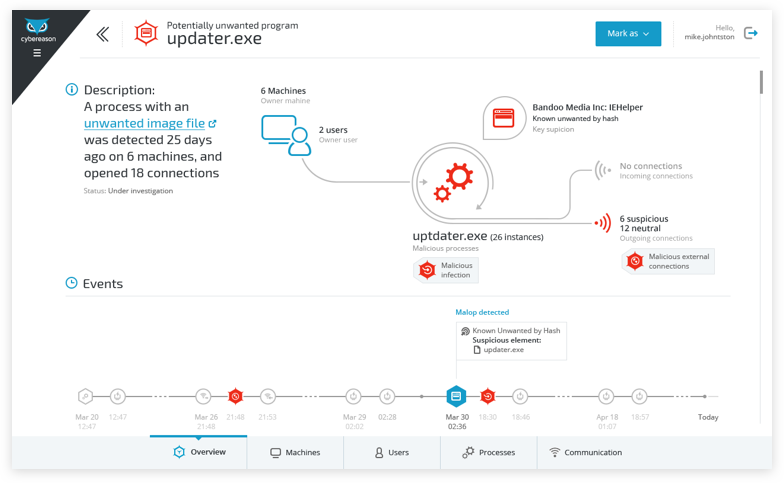
Cybereason’s Malops present customers with actionable data to start hunting. Malops are collections of related suspicious activities that are highly likely part of a security incident. Customers can search for evidence and suspicions tied with Malops to see how prevalent they are in their environment.
With Cybereason’s query builder, you don’t need to learn advanced queries to hunt. Instead, query builder is an interactive hunting tool that lets you hunt easily based on IOCs, threat intelligence, observed behaviors, processes, and more. Furthermore, since each Cybereason customer has their own graph database, query results are instantaneous.
The ability to automate hunting processes is critical to reducing the time needed to identify new attacks. Cybereason automates threat hunting by eliminating the need for analysts to always run manually queries for specific malicious activity. Instead, analysts can create custom detection rules and define new logic for triggering Malops based on lessons learned from successful hunts.
Whether the process is called threat hunting, cyber hunting or cyber threat hunting, each term essentially means the same thing: security professionals look for threats that are already in their organization’s IT environment. This differs from penetration or pen testing, which looks for vulnerabilities that an attacker could use to get inside a network.
With every vendor offering some type of threat hunting service, security professionals may wonder if hunting can actually benefit a company or if it’s just a fad. But threat hunting isn’t based on flashy technology that will become irrelevant in a few months. It’s a return to one of the basic tenets of information security: reviewing your IT environment for signs of malicious activity and operational deficiencies.